
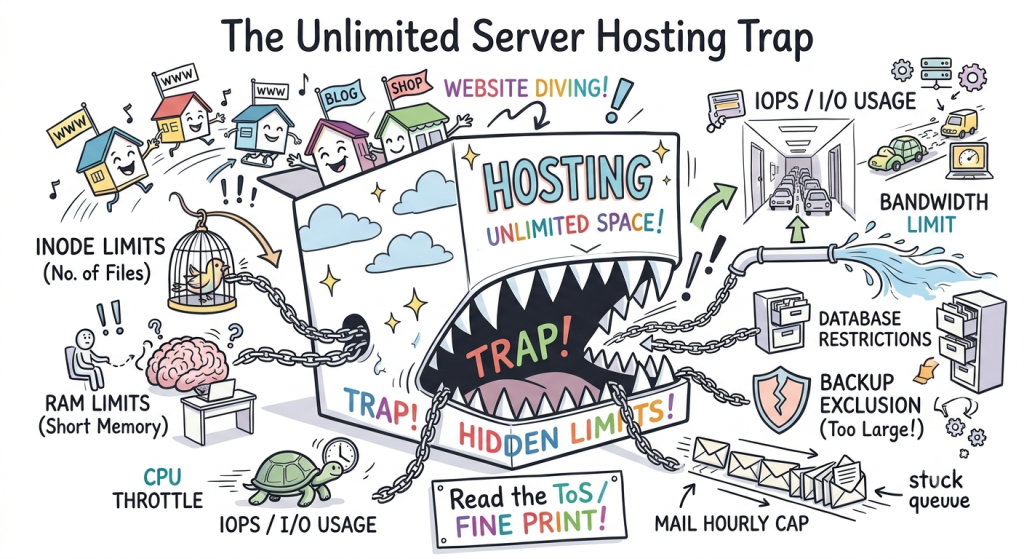
Budget web hosting providers often lure web developers and business owners with enticing “unlimited storage and bandwidth” promises, but these offers mask strict, physical hardware limits and hidden legal restrictions. Beneath the marketing hype lie technical bottlenecks like inode file caps, CPU throttling, and database locks that can silently crash growing sites. To protect your revenue, look past deceptive marketing buzzwords, audit terms of service closely, and choose transparent providers offering predictable infrastructure that scales reliably alongside your business growth.
TL;DR Key details you should look for in your web hosting provider
If you want to know about the lesser-known details of web hosting servers, use this summary table to plan your website and email needs:
Trap / Caveat | What the Marketing Implies | The Hidden Reality |
Email Sending Limits | “Create unlimited email addresses and send freely.” | The email sending can be capped around at 100–500 outbound emails per hour; breaking it stalls newsletters and transactional alerts. |
Database Bloat Caps | “Store as much data as your database can take.” | Often the database size can be limited by max database size (e.g., 5GB) or individual table limitations, choking large e-commerce platforms. Causing problems for e-commerce and dynamic websites. |
Backup Exclusion Rules | “Your whole site is safely backed up automatically.” | Many hosts can disqualify accounts exceeding a specific file count or size threshold from automated backup rotations or not be able t automatically backup the website periodically. |
Entry Processes (EP) | “Your site handles traffic smoothly.” | Limits the number of dynamic script executions allowed at once, triggering 508 errors during traffic spikes. |
The FUP Suspension Clause | “As long as it’s legal, you can host it.” | A subjective clause allowing hosts to shut down or throttle or limit your account if your background server resource utilization. |
1. Uncovering the truth of ‘Unlimited Hosting”
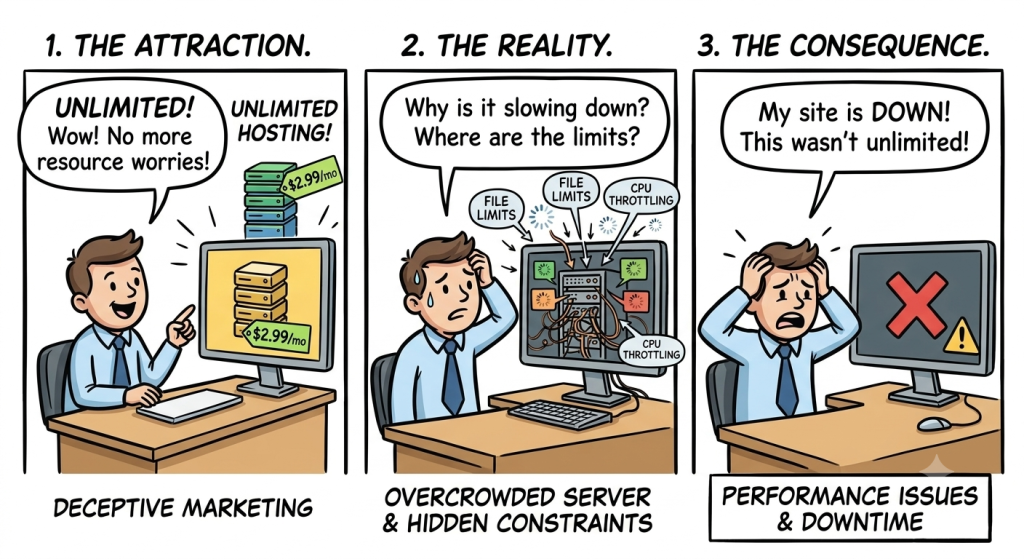
Imagine a typical scenario familiar to many digital entrepreneurs, developers, and small business owners. You are searching for a reliable home for a growing website, and you stumble upon an irresistible hosting provider offering a seemingly miraculous deal: unlimited storage, unlimited bandwidth, and unlimited databases for a very good price, for example only $2.99 a month. Tempted by the prospect of absolute freedom from resource limitations, you migrate your entire application or online store to their servers, fully expecting that your site can expand indefinitely without any infrastructure hurdles or extra costs. For the first few weeks, everything runs smoothly, and it feels like you have unlocked the ultimate shortcut in digital infrastructure.
However, this illusion of boundless digital real estate eventually collides with the unyielding laws of the physical world. In reality, physical hardware is inherently finite and bound by strict engineering limitations. Solid-state drives, NVMe storage modules, RAM sticks, CPU cores, and network interface cards all possess hard ceilings on their capacity and throughput. No data center, no matter how massive or technologically advanced, can bypass the laws of physics. A single server chassis has a definitive maximum amount of power it can draw, a strict threshold of data it can transfer per second, and a finite amount of space to store ones and zeros. When a hosting provider slaps the word unlimited onto a shared server, they are describing a marketing concept rather than a physical reality, masking a system that is fundamentally constrained by hardware boundaries.
Understanding this dynamic reveals the true nature of the industry: so-called unlimited hosting is not an endless supply of infrastructure, but rather unmetered shared infrastructure governed by strict, often hidden constraints. Hosting companies operate on a business model akin to buffet restaurants or airline seat overbooking. They deliberately cram thousands of websites onto the same crowded server, banking on the statistical certainty that the vast majority of users will consume only a fraction of a percent of the resources available. They wager that ninety-five percent of accounts will use almost nothing, which subsidizes the cost and provides enough margin to quietly penalize, throttle, or outright suspend the remaining five percent who actually test those boundaries. Behind the polished marketing promises lies a web of strict file-count limits, CPU throttling scripts, and sudden terms-of-service violations designed to push heavy users off the platform before they can strain the shared environment.
This delicate balancing act creates a precarious environment for anyone trying to build a sustainable online presence. When a growing website begins to attract legitimate traffic, process more transactions, or accumulate media assets, it crosses an invisible threshold. Suddenly, the promises of seamless scalability evaporate, replaced by performance bottlenecks, unexplained downtime, or urgent emails from support warning that the site is consuming excessive server resources. For website owners, recognizing the myth of unlimited hosting is the first critical step toward making informed architectural decisions. Moving past deceptive marketing allows developers to choose hosting solutions rooted in transparent hosting service capacity, predictable scaling, and realistic hardware expectations, ensuring that growth is supported by architecture rather than restricted by hidden ceilings.
Feature | Metered Hosting | Unmetered Hosting |
Bandwidth/Data Allocation | Fixed amount per month (e.g., 500 GB or 2 TB). | No fixed data cap; you can transfer as much data as the server allows. |
Overages & Fees | If you exceed your limit, you may face extra fees, automated throttling, or site suspension until the next billing cycle. | No extra charges for high data transfer, but hidden restrictions still apply (e.g., CPU, RAM, or file-count limits). |
Best Suited For | Static sites, portfolios, or predictable workloads where traffic volume is steady and well-understood. | Growing blogs, media-rich sites, or unpredictable traffic spikes where exact data usage is hard to forecast. |
The Catch | You pay explicitly for what you use, but you have a hard ceiling on raw data transfer. | Often marketed as “unlimited,” but you are still bound by server hardware limits and strict terms of service. |
2. The Economics of Overselling and Server Density
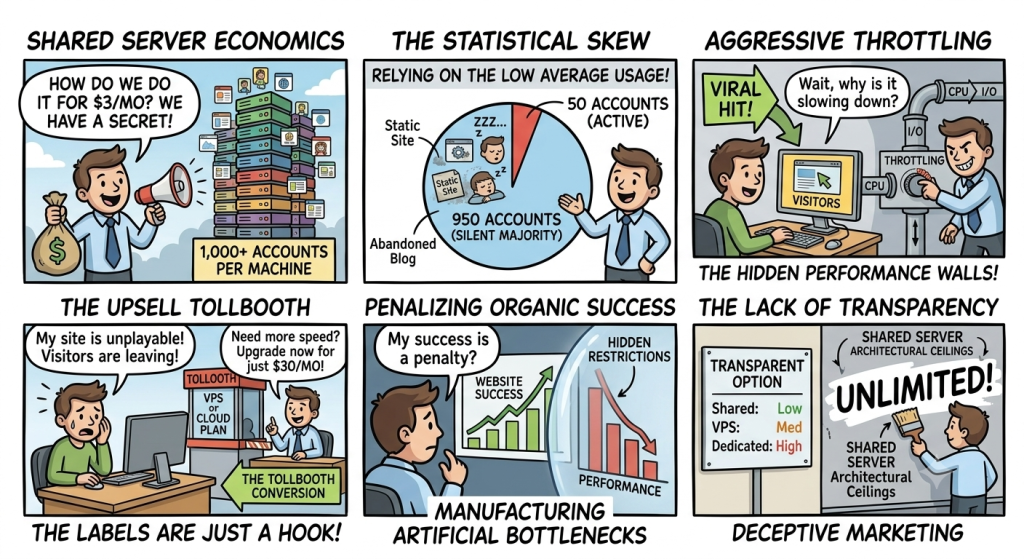
To understand how budget hosting providers can afford to offer “unlimited” plans for a few dollars a month, you have to look closely at shared server economics. A typical web hosting company sets up high-performance physical servers or virtual private servers (VPS) and packs them with hundreds, sometimes between 500 and 1,000—cPanel or DirectAdmin accounts. On paper, cramming that many websites onto a single machine sounds like a recipe for constant crashes. In practice, however, hosting providers rely on a massive statistical skew regarding actual resource consumption.
Out of those 1,000 accounts living on a single server, the vast majority; roughly 950 of them—consist of static brochure websites, low-traffic portfolios, landing pages, or abandoned WordPress installs. These sites sit idle for nearly 24 hours a day, consuming virtually zero disk space, barely registering on RAM utilization, and drawing negligible CPU power. The entire business model is built entirely on the low average usage of this silent majority, using their collective headroom to absorb the heavier resource demands of the remaining minority.
This business model operates as a carefully engineered funnel designed to convert cheap accounts into high-margin plans. Because physical hardware cannot support 1,000 genuinely active websites running heavy scripts simultaneously, providers use aggressive, non-storage throttles. When a website starts gaining traction, executing complex database queries, or receiving regular traffic, it immediately triggers resource limits regarding CPU cycles, input/output operations per second (IOPS), or concurrent database connections.
Rather than shutting down the site entirely, these performance bottlenecks make the website painfully slow, frustrating visitors and forcing the owner to look for a solution. At that exact moment, the hosting provider steps in with a convenient fix: an upsell. They gently nudge or directly require the user to abandon the low-margin $3-per-month “unlimited” shared tier and migrate to a high-margin $30-per-month VPS or managed cloud plan. In short, the “unlimited” label serves as a brilliant marketing hook to capture volume, while the invisible performance walls act as a tollbooth guiding growing businesses into expensive enterprise tiers.
If the hosting provider were transparent from the beginning, such slowness could easily be understood as a natural consequence of website growth; a clear indicator that the site’s rising popularity demands more resources than an entry-level plan can provide. Instead, deceptive “unlimited” marketing masks these genuine architectural ceilings behind hidden restrictions, penalizing organic success and manufacturing artificial bottlenecks to drive conversions.
3. The Core Technical Bottlenecks you will find in an “Unlimited Hosting” (The Usual Suspects)

To understand why these Unlimited Hosting plans fail growing businesses, it helps to look past the marketing and examine the invisible walls built into shared hosting infrastructure.
1. Inode Limits (The File Ceiling)
- What it means in plain English: Think of this as a strict limit on the total number of items—individual files, images, code scripts, and folders—you are allowed to keep in your digital filing cabinet, regardless of how much actual storage space (gigabytes) they take up.
- How it breaks your business: Modern content management systems like WordPress love to multiply files behind the scenes. Every time you upload a single product photo, your website automatically generates three or four different thumbnail sizes for mobile, tablet, and desktop views. Add in plugins, security logs, and temporary cache files, and your site can quietly rack up hundreds of thousands of invisible items. Once you hit that file ceiling, your server locks up entirely. You won’t be able to upload new inventory, process customer updates, or save changes, even though your disk space meter says you are only using a fraction of your allowance.
2. CloudLinux LVE Limits (CPU & RAM Caps)
- What it means in plain English: In a shared hosting environment, your website shares a single physical computer with hundreds of other companies. To keep one busy site from crashing everyone else, providers use invisible safety containers that strictly limit your account’s share of the computer’s brainpower (CPU) and short-term memory (RAM).
- How it breaks your business: These containers are usually capped at tiny minimums, such as just a fraction of a processor and one or two gigabytes of RAM. If your business experiences a sudden spike in customer traffic—perhaps from a successful marketing campaign, a newsletter blast, or a social media mention—your site will instantly slam into these processing walls. The server responds by throwing frustrating 503 Service Unavailable or 508 Resource Limit Reached errors to your visitors. You lose sales not because your server ran out of storage, but because it ran out of processing power to handle the crowd.
3. IOPS & Disk I/O Throttling (Database Traffic Jams)
- What it means in plain English: This measures how fast data can be read from or written to the hard drive—essentially, how quickly your server’s storage can process back-and-forth communication.
- How it breaks your business: Behind every business website—whether it is a booking portal, a product catalog, or a checkout system—lies a database managing your customer data. Budget hosting providers strictly throttle this disk speed. When multiple customers browse your catalog, filter products, or complete transactions at the same time, your database operations are forced to wait in a virtual traffic jam. For your visitors, this translates to agonizingly slow page loads. In digital commerce, a delay of even a few seconds directly tanks your conversion rates as frustrated shoppers abandon their carts and head to your competitors.
4. Bandwidth Port Speed Throttling (Network Bottlenecks)
- What it means in plain English: While total monthly data transfer might technically be labeled as “unmetered,” the simultaneous network connection speed assigned to your individual account at any given second is heavily capped.
- How it breaks your business: Think of it like a highway where there is no monthly limit on how many cars can travel, but the tollbooth lane is narrowed down to a single trickle. If several customers try to download heavy brochures, high-resolution product galleries, or video assets at the exact same time, the server chokes the connection, causing media delivery to stall completely for subsequent visitors.
What This Means for Your Business
These restrictions are not accidents; they are engineered boundaries. When your business grows past the point of a quiet brochure site, these hidden technical traps force you into a frustrating corner. Instead of transparent hosting server scaling based on your actual business growth, you are abruptly hit with performance penalties that push you toward expensive, high-tier enterprise plans. Recognizing these invisible limits early helps you choose infrastructure that scales alongside your revenue, ensuring your digital storefront remains fast, reliable, and open for business.
It is worth noting that this dynamic is primarily true for unlimited hosting providers who rely on aggressive overselling. A reputable, high-quality hosting provider will always be upfront about their server limitations, hardware allocation, and clear pricing plans from the beginning. Transparent hosting server providers ensure you are never blindsided by unexpected downtimes driven by the physical limitations of shared hardware, allowing you to upgrade intentionally before your business outgrows its environment.
When you sign up for an “unlimited” hosting plan, the glossy marketing page paints a picture of complete freedom. But if you dig past the surface and read the dense legal text buried deep inside the Terms of Service (ToS) and Acceptable Use Policies (AUP), a very different picture emerges.
To protect their oversold infrastructure, budget providers rely on strict, hidden clauses that legally permit them to throttle or penalize your site the moment you actually try to use the resources you were promised.
A. The Outbound Email / Transactional Mail Wall
- The Promise: “Unlimited Email Accounts and Storage.”
- The Reality in Plain English: While you can technically create endless mailboxes, outbound emails are aggressively restricted—usually capped at just 50 to 100 emails per hour per account to prevent the server’s IP address from being blocklisted for spam.
- How it breaks your business: For an active e-commerce store, this limitation is disastrous. During high-traffic periods, critical automated messages—such as customer password resets, urgent order confirmations, and WooCommerce invoices—will stall out or be dropped entirely by the server, leaving your customers in the dark.
B. Database Size & Table Constraints
- The Promise: “Unlimited MySQL Databases.”
- The Reality in Plain English: Providers may let you create as many databases as you want, but they enforce strict, unpublicized caps on individual database sizes (often limiting them to 2 GB or 5 GB) and restrict concurrent database connections to a trickle of 10 to 15 at a time.
- How it breaks your business: Growing websites naturally accumulate data. As your WooCommerce order history grows or plugins expand your core data tables (wp_postmeta and wp_options), your database will hit invisible read/write locks, causing checkout failures and admin panel freezes.
C. Entry Processes (EP) & Concurrent Request Limits
- The Promise: “Handles Unlimited Traffic.”
- The Reality in Plain English: Shared hosting accounts enforce an Entry Process (EP) limit, which controls how many dynamic PHP scripts can run at the exact same millisecond—typically capped between 10 and 20 processes.
- How it breaks your business: This has nothing to do with monthly visitor counts and everything to do with timing. If 15 customers click a link or load a dynamic page at the exact same microsecond, your account hits its ceiling. The 16th visitor doesn’t just wait—they are instantly slammed with a hard HTTP 508 error page.
D. The Backup Exclusion Clause
- The Promise: “Automated Daily Backups Included Free.”
- The Reality in Plain English: Buried in the fine print is a quiet safety escape hatch for the provider: accounts that exceed a certain size threshold—such as 20 GB of storage or 100,000 inodes—are automatically excluded from the automated backup system.
- How it breaks your business: The irony of this clause is brutal. The moment your website grows, becomes successful, and actually needs reliable backups the most, it quietly loses its safety net. If a plugin update breaks your site or a database corrupts, you may find that your automated recovery points vanished weeks ago.
E. The Vague “Fair Usage Policy” (FUP) & Archiving Ban
- The Promise: “Store as much as you need for your website.”
- The Reality in Plain English: Acceptable Use Policies explicitly ban using your hosting account for file archiving, personal computer backups, raw video hosting, or large downloadable assets.
- How it breaks your business: Because these rules are intentionally broad and subjective, hosting companies can invoke the generic “unreasonable server load” clause at any time. If you upload a few large zip files, host your own promotional video clips, or store heavy media assets, your account can face immediate suspension without warning—leaving your live business offline while you scramble for answers.
So in this time when information is freely accessible for almost anything, transparency is the key for the successful growth of a website. Choosing a partner who lays out their hardware limitations and terms clearly ensures that your digital infrastructure can evolve right alongside your ambitions.
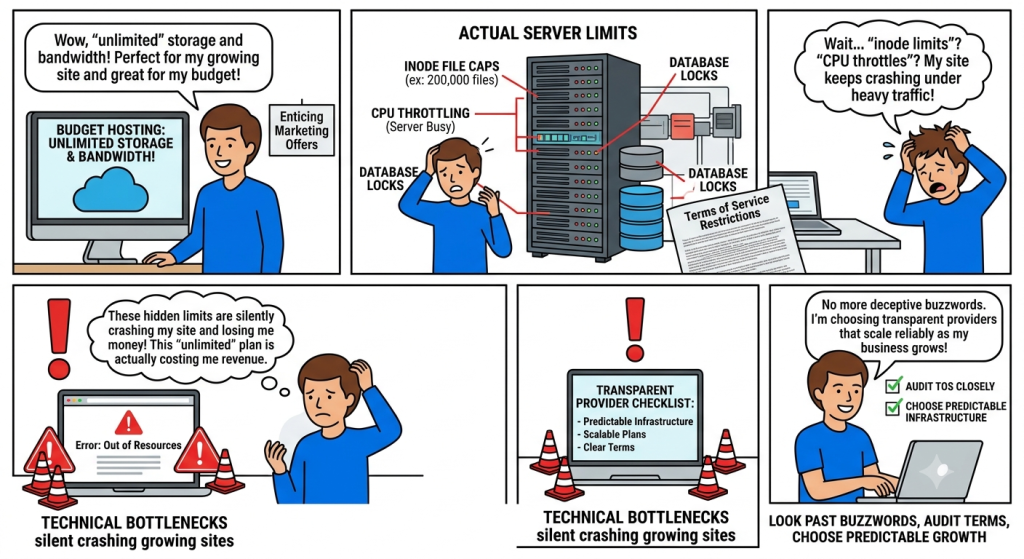
When evaluating web hosting providers, it is easy to get swept up in flashy marketing banners and low introductory prices. However, protecting your business requires looking past the sales pitch and conducting a proactive audit of what you are actually buying.
Equipping yourself with a concrete action plan ensures you can spot hidden ceilings before they threaten your website’s uptime and growth.
A. Terms of Service (ToS) & AUP Keyword Hunting
Before entering your credit card information, open the provider’s legal documents—specifically their Terms of Service (ToS) and Acceptable Use Policy (AUP). Use your browser’s search function (Ctrl + F or Cmd + F) to hunt down these exact terms, which reveal the real technical boundaries:
- Inode: Checks if there is a strict, unpublicized file ceiling on your account.
- Entry Processes / EP: Reveals how many dynamic scripts can run simultaneously before your visitors hit error pages.
- Nproc: Highlights the maximum number of simultaneous processes or tasks your account can run at once.
- Concurrent connections: Shows how many active visitors or database requests can connect to your server at the exact same millisecond.
- Acceptable Use: Uncovers broad clauses that ban common business practices like file archiving or media hosting.
- Backup limits / Exclusion: Exposes the hidden size or file thresholds where your automated recovery points quietly switch off.
- Hourly limit / SMTP: Reveals outbound email caps that can break your transactional mail and password resets.
B. The Live Chat Pre-Sales Audit Script
Marketing pages rarely list technical specifications, but support and sales teams are often bound by accuracy when directly questioned. Copy and paste these exact questions into a pre-sales live chat window to get concrete answers:
- “What is the exact numerical Inode limit for this plan?”
- “What are the CloudLinux LVE limits assigned to this account (CPU cores, RAM, IOPS, Entry Processes)?”
- “What is the maximum allowed size for a single MySQL database?”
- “What is the hourly outbound email limit per domain?”
- “At what storage or inode threshold do automated backups cease for an account?”
If the support agent responds with vague phrases like “Our resources are unlimited as long as you follow fair usage,” consider it a red flag. Transparent Hosting providers will give you clear, precise numbers.
C. Choosing Transparent Hosting Provider
The ultimate alternative to oversold shared hosting is choosing infrastructure rooted in predictable capacity. Instead of falling for “unlimited” plans, look for providers that offer explicit, fixed resource allocations—such as plans clearly defined by specific hardware specs (e.g., 2 vCPU, 4GB RAM, 50GB NVMe Storage, and 500,000 Inodes).
Predictable limits lead to superior reliability and simpler architecture planning. When you know your exact boundaries, you can monitor your growth honestly, optimize your website proactively, and scale your resources smoothly without ever fearing sudden, unexplained downtime.
For SME or Medium size companies RAM of 1 GB -2GB with a Storage of 10GB is perfectly normal for starting out. Later it can be upgraded as needed.
Hosting Tier / Purpose | Realistic Server Resources | Estimated Price Range |
Micro / Personal Blog | • RAM: 1 GB – 2 GB • Storage: 10 GB – 25 GB NVMe • IOPS: 200 – 500 • Disk I/O: 10 MB/s • Bandwidth: 1 TB | ₹400 – ₹1,000 / month ($5 – $12 / mo) |
SME Starter / Small Business | • RAM: 2 GB – 4 GB • Storage: 50 GB NVMe • IOPS: 500 – 1,000 • Disk I/O: 25 MB/s • Bandwidth: 2 TB – 4 TB | ₹1,000 – ₹2,500 / month ($12 – $30 / mo) |
E-Commerce / Growth Site | • RAM: 4 GB – 8 GB • Storage: 80 GB – 160 GB NVMe • IOPS: 1,500 – 3,000 • Disk I/O: 50 MB/s – 100 MB/s • Bandwidth: 5 TB | ₹2,500 – ₹5,000 / month ($30 – $60 / mo) |
Enterprise / High Traffic | • RAM: 16 GB+ • Storage: 320 GB+ NVMe • IOPS: 5,000+ • Disk I/O: 200+ MB/s • Bandwidth: 8 TB+ | ₹8,000 – ₹16,000+ / month ($100 – $200+ / mo) |
Navigating complex hosting requirements, database sizing, and server configurations doesn’t have to be a guessing game.
If you are scaling an e-commerce store, building a custom web application, or migrating away from restrictive shared hosting, Ultimate Coder offers transparent hosting server consultation to help you architect the right infrastructure from day one. To get expert guidance tailored to your project, you can reach out directly by emailing info@ultimatecoder.in.
6. Choosing Predictable Performance Over Empty Promises
When it comes to web hosting, the age-old adage holds true: if a deal sounds too good to be true, the cost is hidden in the fine print.
Knowing when to use budget options versus when to invest in robust infrastructure depends entirely on your digital footprint:
- When “Unlimited” Hosting Is Fine: These plans are perfectly acceptable for small personal sites, static brochure pages, low-traffic portfolios, or dormant blogs that sit quietly on the web and require minimal system resources.
- When to Avoid Unlimited Hosting: If you are running an e-commerce store (like WooCommerce or Magento), a web application, a membership portal, a high-traffic content site, or a demanding client project, stay far away from unmetered shared tiers. These platforms require consistent processing power and reliable database speeds that budget oversellers simply cannot support.
Ultimately, your website’s success relies on stability and trust. Pay for defined, transparent server resources rather than falling for marketing buzzwords. Choosing clear, predictable capacity ensures that your digital presence grows unhindered, keeping your business fast, secure, and always open for customers.
Need help designing a bulletproof hosting architecture or auditing your current setup? Ultimate Coder provides expert hosting server consultations to match your application with the right hardware stack. Get in touch with the team today by emailing info@ultimatecoder.in to secure your digital infrastructure.

